PREAMBLE:
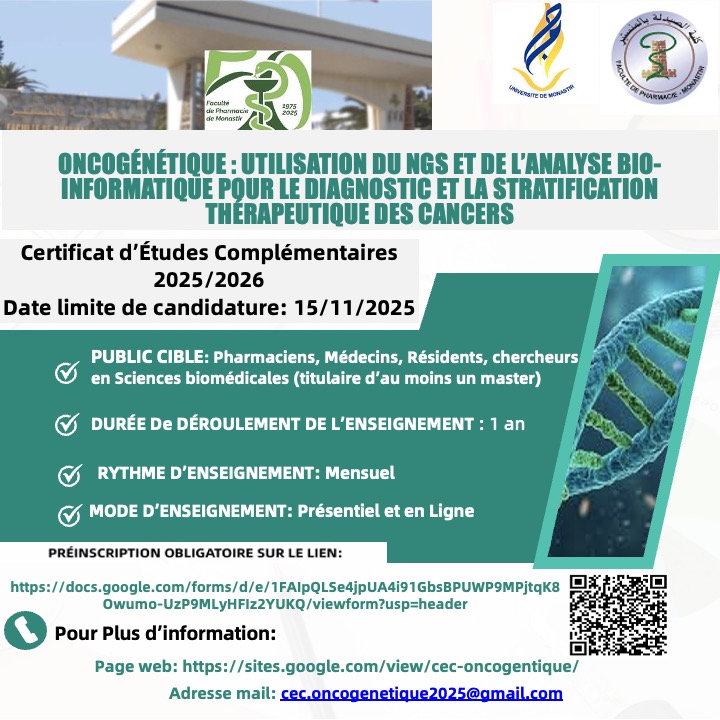
The Faculty of Pharmacy of Monastir announces the launch of a new Certificate of Complementary Studies (CEC) entitled: “Oncogenetics: Application of NGS and Bioinformatics Analysis for Cancer Diagnosis and Therapeutic Stratification.”
This program is intended for pharmacists, physicians, medical residents, and researchers in biomedical sciences (holding at least a Master’s degree) who wish to deepen their understanding of genes involved in carcinogenesis, the underlying molecular mechanisms, and laboratory techniques for detecting genetic alterations.
The training will cover both conventional and modern genetic approaches, with a particular focus on Next-Generation Sequencing (NGS) technologies, including their platforms, sequencing capacities, and applications in oncology.
The CEC will also include practical modules dedicated to bioinformatics analysis and variant interpretation.
This program represents a unique opportunity to strengthen participants’ expertise in genetic cancer diagnostics, advance their translational or clinical research projects, and broaden their perspective in the field of personalized medicine in oncology.
TARGET AUDIENCE:
This program is designed for professionals and postgraduate students, including residents and doctoral candidates. The specific target audience includes:
- Pharmacists and Physicians
- Residents
- Researchers (holding at least a Master’s degree)
SPECIFIC OBJECTIVES
The specific objectives of this CEC are as follows:
· Master key cancer-associated genes: Identify and understand the role of major genes involved in carcinogenesis, as well as the underlying molecular mechanisms.
· Differentiate genetic alterations: Recognize the main types of genetic anomalies in cancer, distinguishing somatic mutations from hereditary mutations.
· Acquire foundational skills in cytogenetic and molecular diagnostic tools: Understand conventional techniques used in oncology such as cytogenetic diagnosis, karyotyping, FISH, RT-PCR, and Sanger sequencing.
· Become familiar with Next-Generation Sequencing (NGS): Understand the technologies and methodologies of NGS, as well as its diverse applications in the field of oncology.
· Develop basic skills in bioinformatics analysis: Learn to handle and interpret results from primary and secondary bioinformatics analyses and understand their biological significance.
· Understand the process of Molecular Multidisciplinary Tumor Boards (RCP): Grasp the objectives, methodology, and workflow of tumor boards where personalized therapeutic strategies are discussed based on molecular findings.
· Explore the use of NGS and genomic data in Biotech and startups: Discover innovative approaches for applying sequencing data in scientific research and therapeutic innovation in oncology.
· Integrate ethical considerations in oncogenetics: Become aware of the ethical challenges related to sequencing technologies, genetic data management, confidentiality, and data sharing.
THEMES AND TEACHING SCHEDULE
The teaching program of this certificate is organized around
six complementary modules:
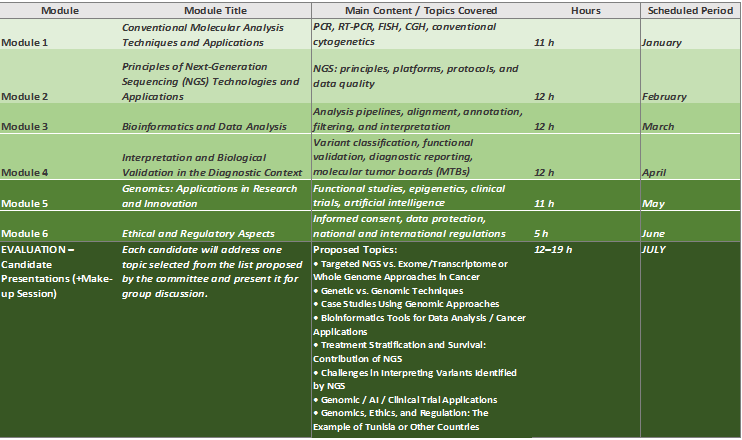
- Module 1: Conventional molecular analysis techniques and their applications
- Module 2: Principles of Next-Generation Sequencing (NGS) technologies and their applications
- Module 3: Bioinformatics analysis and processing of genomic data
- Module 4: Interpretation and biological validation within a diagnostic framework
- Module 5: Genomics: applications in research and innovation
- Module 6: Ethical and regulatory aspects
Each module consists of several
teaching units (UE) detailed in the table below, specifying the
number of teaching hours and the
scheduled month.
The
exact dates of the sessions will be communicated to the enrolled candidates at the start of the CEC.
Teaching will be provided by
national and international experts in the fields of
genomics,
oncogenetics, and
bioinformatics.
At the end of the training cycle,
participant evaluation will include:
- the writing of a short dissertation on a topic related to the subjects covered during the program.